
 Image 1 of 4
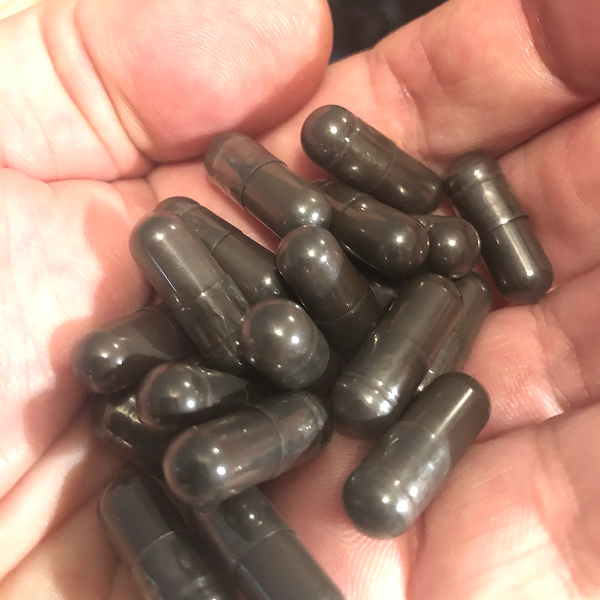 Image 2 of 4
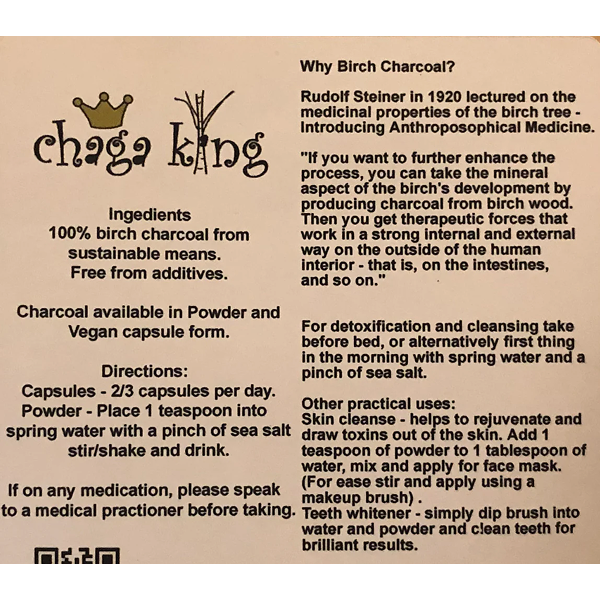 Image 3 of 4
 Image 4 of 4
Key Benefits
Contrary to popular belief, the idea that charcoal interferes or neutralizes healthy nutrients, minerals, vitamins, fat/oils, carbohydrates and/or protein has never been proven in research. Charcoal is able to selectively neutralize toxins without interfering with healthy digestion and metabolism via two scientific principles discovered so far: van der waal's forces and pi stacking.
Researchers are actively exploring other potential benefits of charcoal as well, including treatment of indigestion, heavy bile flow during pregnancy and neutralizing the toxic effects of some anti-seizure medications. (2)
Charcoal adsorbs toxins, metabolic waste products and artificial chemicals that can damage the body. Charcoal has been found to be safe for all ages. Start slow as charcoal is a binder and excessive use (initially) may lead to constipation.
Hospitals recommend that charcoal should be taken at least 2 hours apart from medication, as charcoal can neutralize medication when taken together. One may want to take charcoal on the opposite side of the day as medication.
Charcoal is often used to treat acute poisonings. With daily use, research suggests activated charcoal may promote kidney health, reduce flatulence, calm diarrhea and boost skin health. (1)

Birch Charcoal Qualities:
Premium Grade Charcoal
Manufactured in the United Kingdom
Vegetarian Capsules
Bio-Degradable Packaging
Non-Activated (Charcoal)
Paleo
Wildcrafted
Pesticide-Free
Accelerant-Free
Non-GMO
Allergen Free
Vegan (Plant-Based)
Remember: Charcoal is a Symbol of Transformation
Special Note
If you are currently on prescribed medication, please consult with your medical practitioner for advice on using Charcoal. Charcoal is regularly used at a detoxifier/cleanser in Hospitals and Emergency Rooms to remove excess alcohol, certain poisons and drugs. Thus the charcoal may have similar effects on your daily medication.
Rudolf Steiner on Birch Charcoal
In 1920, philosopher Rudolf Steiner (founder of Biodynamic Farming and Waldorf Education) stated the following:
'If you want to further enhance the [detoxification] process, you can take the mineral aspect of the birch's development by producing charcoal from birch wood. Then you get therapeutic forces that work in a strong internal and external way on the outside of the human interior — that is, on the intestines..."
More on Activated Charcoal (remember: Birch Charcoal is not activated, so not as strong)
Dr. V. V. Frolkis, a famous Russian Gerontologist, and his colleagues discovered that activated charcoal is a potent life-extending agent. (3) Activated charcoal has been found to increase the mean lifespan of older test animals by 43% and their maximum lifespan by approximately 34%.
Activated charcoal decreases the age-related increase in the brain's sensitivity to drugs and toxins.
Activated charcoal normalizes cholesterol and lipid metabolism.
The regular use of activated charcoal improves the adaptive functioning of essential organs (the liver, kidneys, and adrenals). That translates into better defense mechanisms.
Sources
(1) https://www.medicalnewstoday.com/articles/322609.php
(2) https://www.webmd.com/vitamins/ai/ingredientmono-269/activated-charcoal
(3) Frolkis VV, Nikolaev VG, Paramonova GI, Shchorbitskaya EV, Bogatskaya LN, Stupina AS, Kovtun AI, Sabko VE, Shaposhnikov VM, Muradian KK, et al.
Institute of Gerontology AMS (Russia)
Abstract: Experiments were performed on Wistar male rats, starting from the 28th month of age. The effect of dietary sorbent (non coated nitrogen-containing carbon administered as 10 day courses at 1 month intervals in dosage of 10 ml/kg) on lifespan and a number of biological indices were studied. Enterosorption resulted in the increase of mean and maximal lifespan by 43 and 34% respectively. Analysis of the effect of enterosorption on activity of microsomal enzymes, intensity of total RNA and protein biosynthesis, lipid metabolism, formation of free radicals etc. showed that it produced a positive influence on the functional state of the studied systems and increased the organism's adaptive capacities. Enterosorption was found to delay the rate of onset of age-related structural changes in the organs and tissues.